Street Photography: The Ultimate Guide to Candid Urban Photos
📝 Step-by-Step Guide: Street Photography Essentials
Introduction
Street Photography is a practice of observing and documenting public life. In addition, it blends photojournalism, portraiture, and fine art to produce images that convey mood, context, and narrative. Therefore, this guide presents a pragmatic workflow you can use on every outing. It covers planning, gear, in-field technique, and post-production. For example, you will learn how to anticipate moments, use zone focusing, and sequence images for projects. Street Photography techniques are applicable whether you pursue candid street photography on a daily walk, or build a long-term documentary series.
Before You Go: Planning and Mindset
Define intent before you leave home. Decide if you are shooting a short practice session, a portfolio piece, or a longer documentary project. Scout locations using maps and social media. Also, check light and timing: golden hour gives warm rim light; mid-day can produce hard shadows; neon offers color contrast at night. In addition, review local laws and ethical concerns. Understand when consent is required and when public photography is permitted. As a result, you will reduce legal risk and shoot with confidence.
Practical Defaults — Gear and Camera Settings
Choose gear that supports discretion and speed. Many photographers favor a mirrorless body with one or two primes. A 35mm or 50mm prime is ideal for candid street photography. For general recommendations, use these starter settings in daylight: aperture f/5.6, shutter 1/250s, ISO auto with a max of 3200, and continuous AF or back-button focus for control. At night, switch to wider apertures (f/1.8–f/2.8) and raise ISO tolerance to 6400 if needed.
On the Street: Composition and Approach
Walk slowly and observe patterns of behavior. Anticipate interactions rather than chase them. Use layers — foreground, subject, and background — to create depth. Pre-visualize frames and wait for decisive human gestures. Respect personal space, and blend into the environment by dressing neutrally and moving naturally. In addition, use reflections and shadows to create creative frames while staying unobtrusive.
Shooting Techniques and Immediate Workflow
Practice zone focusing for predictable range shots and hyperfocal focusing for wide environmental scenes. When possible, shoot RAW; this gives latitude for exposure and white-balance adjustments. Immediately after a session, back up files to at least two locations. Then cull rapidly: mark the strong images, and delete clear misses. Edit with intention — global adjustments first, then local refinements. Finally, export web (sRGB) and print (AdobeRGB or ProPhoto) versions and add metadata with keywords such as Street Photography, street photography tips, candid street photography, and urban photography.
📌 Practical Applications: Street Photography Uses
Photojournalism and Documentary
Street Photography methods directly translate to documentary work. For instance, capturing decisive moments is useful for covering protests, transit life, and community stories. In addition, sequences of images build narratives that single frames cannot. Therefore, plan captions and dates to strengthen editorial value.
Commercial, Editorial, and Stock
Urban street photography is widely used in advertising, magazines, and lifestyle editorial. However, note that commercial licensing generally requires model releases for recognizable people. For stock usage, prepare both editorial and release-cleared images. In addition, natural, candid portraits often perform well for brands that seek authenticity.
Fine Art, Exhibitions, and Teaching
Use thematic projects to create gallery-ready work. Sequence images to develop rhythm and tension across prints. Furthermore, teach workshops that combine candid technique with legal and ethical practices. Practicing with students in live shoots improves both technical skills and visual judgment.
What specific local moment or public space would you like to document next, and why does it matter to your project?
Street Photography also supports teaching and content creation. For example, create a micro-course focusing on candid portraits, or sell a city-specific stock pack for travel clients. In addition, you can offer portfolio reviews and curated series to magazines and galleries. Ultimately, choosing an application clarifies how you shoot, edit, and license images.
💡 Tips & Tricks: Street Photography Mastery
Blend In and Move Like a Local
Dress neutrally and avoid flashy camera straps. Use a crossbody bag and smaller lenses for discretion. Hold the camera low and use the articulating LCD to shoot from the hip when needed. As a result, people are less likely to react to your presence.
Master Zone Focusing and Pre-Visualization
Set a focus distance and aperture to create a “sweet spot” of sharpness. For example, pre-focus to 3–5 meters at f/8 for predictable candid heads-and-shoulders shots. In addition, visualize frames and wait for subjects to enter them rather than chasing movement.
Use Light Deliberately
Backlight creates rim highlights and separation. Side light sculpts faces and textures. At night, use practical neon and shop windows for color contrast. However, meters can be fooled in mixed light, so shoot RAW and correct exposure in post.
Find Stories in Small Details
Hands, shoes, and gestures often reveal narrative without showing faces. Furthermore, look for visual juxtapositions — for example, a tailored suit next to graffiti — to add context and tension to your frame.
Take one hour today to work only on framing negative space — then review how isolation and scale change the story in your images.
Work the Scene and Sequence
Stay in one location once you find a promising subject. Shoot wide, medium, and tight. Capture the environment, the interaction, and a detail. This process creates short series that can be edited into a coherent narrative.
Shoot for Projects, Not Singles
Projects build momentum and market value. Choose a theme such as commuters, late-night vendors, or public markets, and return repeatedly. Over time, your series will reveal patterns and nuance that single frames cannot.
📸 Sample Scenario
Scenario Overview
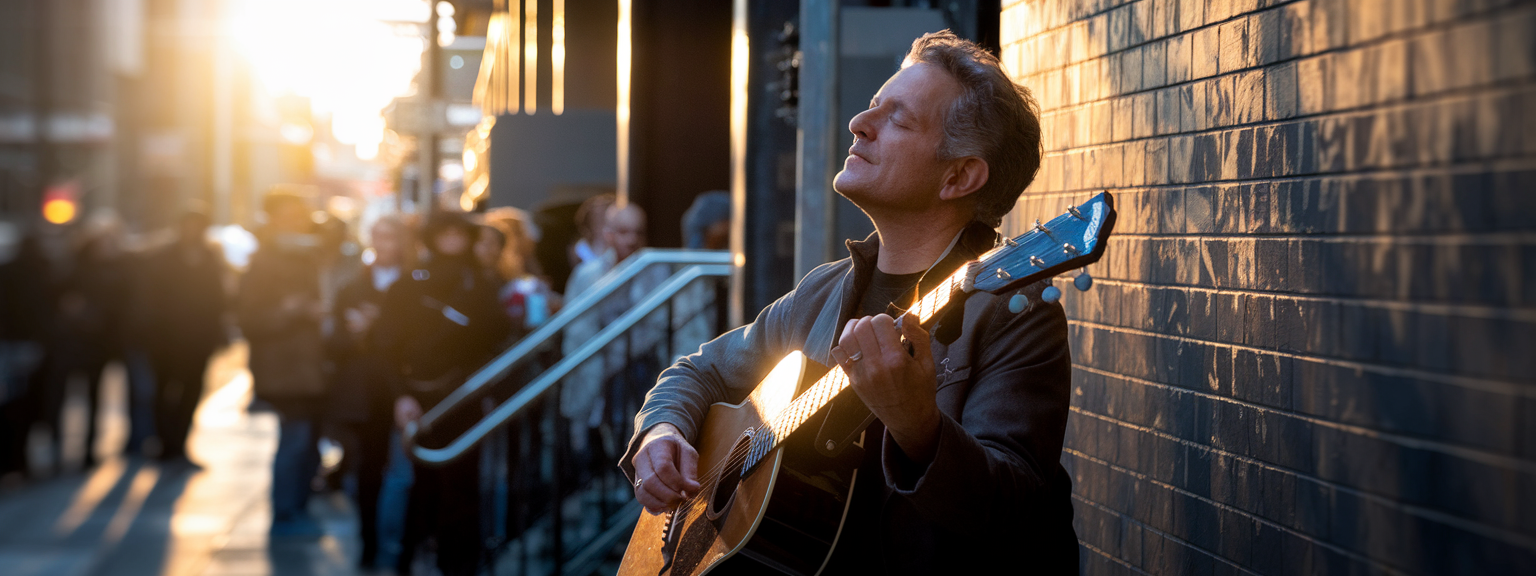
Location: Busy downtown corner near a subway entrance during golden hour. Subject: Mid-aged street musician playing acoustic guitar while a small crowd forms. Goal: Capture an intimate candid portrait that also shows environment and context.
Step-by-Step Execution
- Arrive 30 minutes early to observe light and crowd flow.
- Choose a 35mm lens for context. Set aperture f/2.8 for shallow depth with room to crop.
- Use AF-C with a single zone on the musician’s face; enable silent shutter if available.
- Blend in by sitting on a step and using the LCD for discreet composition.
- Shoot variations: wide environmental shot, mid portrait, hand detail on the guitar.
- If approached, be polite and offer to show the image. If they consent, request a name for credit.
- Back up images immediately to a phone or SSD while still on location.
Editing Decisions
Select the frame with the strongest emotional connection; then apply global exposure and contrast adjustments. Warm the midtones slightly and sharpen the eyes. Also create a black & white variant to emphasize expression and texture. Tag metadata with Street Photography, candid portraits, and urban photography for discoverability.
Why This Works
Golden-hour rim light isolates the subject from background. The 35mm perspective preserves context while allowing a tighter crop later. Anticipation allowed capture of an emotional beat when the musician closed his eyes, producing a decisive moment that conveys sincerity and focus.
✅ Key Do’s for Effective Usage
Core Practices
- Do define the story before you shoot and set a clear intent.
- Do respect privacy and local photography laws.
- Do shoot RAW, back up immediately, and maintain a consistent workflow.
- Do practice zone focusing and pre-visualization for decisive moments.
- Do create series or projects rather than random single images.
- Do add accurate metadata and alt text including Street Photography and related keywords.
- Do carry minimal gear to stay agile and discreet.
- Do offer polite communication and remove images if requested by subjects.
❌ Common Mistakes to Avoid
Frequent Errors
- Shooting only snapshots without composition. Slow down and frame intentionally.
- Overusing very wide apertures that remove essential context in busy scenes.
- Failing to check backgrounds for distracting elements like poles or trash.
- Chasing subjects. This often ruins candid expressions and makes people uncomfortable.
- Ignoring model release requirements for commercial use.
- Poor backup habits. A lost card can destroy a project.
- Over-processing and heavy sharpening that create unnatural looks.
- Publishing sensitive scenes without editorial judgment and empathy.
🔄 Troubleshooting & FAQs
Quick Fixes
- Out-of-focus candids — use a smaller aperture (f/4–f/5.6) or a wider AF zone; practice zone focusing.
- Motion blur at night — increase shutter speed to 1/125s, raise ISO, or accept blur for creative effect.
- Overexposed highlights — expose for highlights and recover shadows in RAW processing.
- Negative reactions — apologize calmly and offer to delete the photo if requested.
- Camera draws attention — switch to a compact camera, shoot from the hip, or use longer focal lengths from a distance.
Frequently Asked Questions
Q: What gear do I need for street photography as a beginner?
A: Any camera you can use comfortably will work. Start with a compact mirrorless or a small DSLR and a 35mm or 50mm prime. Also carry a spare battery and a fast card.
Q: What are the best lenses for candid street photography?
A: Popular choices are 28mm, 35mm, and 50mm primes. For discreet distance shooting, a 85mm can be useful. Each focal length offers different storytelling capabilities: 35mm for natural context, 50mm for intimate framing, and 28mm for environmental scenes.
Q: How do I photograph candid subjects without being intrusive?
A: Keep distance, blend in with neutral clothing, and use quieter shooting methods. If noticed, be polite and offer to show or delete the image. In addition, use long lenses when appropriate to maintain comfort for the subject.
Q: Can I sell street photos of people?
A: Yes, but for commercial usage you generally need a signed model release if the person is recognizable. Editorial use is more permissive, but check stock agency rules and local laws.
Q: How should I edit street photos for impact?
A: Start with global adjustments — exposure, contrast, and white balance. Crop for stronger composition. Then apply local edits to emphasize the subject. Convert to black & white when color distracts from form and emotion.
Q: What are the best AI tools for productivity?
A: Useful AI tools include Adobe Lightroom’s AI masking and Auto Tone, Topaz Labs for denoise and upscaling, and ChatGPT for captions and artist statements. In addition, AI-assisted culling tools speed selection, while mood-board generators such as Midjourney help plan visual tone. Use AI to augment workflow — not to replace ethical shooting practices.
Q: How do I protect my photos legally?
A: Embed copyright metadata, keep original files, and obtain model releases for commercial use. Learn the photography laws in your city and carry contact information if you are questioned by authorities.
🖼️ Bringing It All Together
Summary Workflow
Street Photography success depends on practice, preparation, and ethical judgment. Start with clear intent, scout locations, use appropriate gear, and apply zone focusing to increase your hit rate. Then back up, cull, and sequence images into coherent projects. In addition, use metadata and optimized alt text to improve online discoverability. For example, alt text such as “Street Photography candid portrait of a busker playing guitar at golden hour” helps both accessibility and SEO.
Ready to turn your images into a short project? Pick a theme, shoot daily for one week, and publish your top ten images as a sequence.
Begin with a small, repeatable exercise: choose a block or a subject and shoot it repeatedly. Over weeks you will refine your eye, improve anticipation, and develop narrative sequencing skills. Finally, remain mindful of people’s dignity and legal constraints when publishing. Street Photography rewards patience, ethical behavior, and consistent practice.
![[Photographer capturing sunrise over coastal cliffs with camera — travel photography tips in practice]](https://lenslesson.com/wp-content/uploads/2025/12/travel-photography-tips-sunrise-cliffs-camera.png "[Travel Photography Tips Sunrise Shot]")
![[Person taking an outdoor portrait demonstrating Quick Photo Tips]](https://lenslesson.com/wp-content/uploads/2025/12/quick-photo-tips-better-photos.png "[quick-photo-tips-outdoor-portrait]")
![[Photographer using high shutter speed to capture an athlete mid-jump in sharp action shots with a blurred background]](https://lenslesson.com/wp-content/uploads/2025/12/action-shots-pro-tips-freeze-motion.png "[Action Shots Athlete Mid-Jump]")
![[Flat-lay of must-have photography gear including camera, lenses, tripod, camera bag, and lighting accessories]](https://lenslesson.com/wp-content/uploads/2025/12/must-have-photography-gear-flatlay.png "[Must-Have Photography Gear Flatlay]")
![[Close-up of a ladybug on a leaf showcasing macro photography detail and texture]](https://lenslesson.com/wp-content/uploads/2025/12/macro-photography-ladybug-close-up.png "[ladybug-macro-photography]")